How can you build a city in a place full of snakes and wild beasts? Discover the amazing story of ‘Uqba ibn Nâfi‘.
More than one thousand three hundred years ago, in a region of North Africa called Ifrîqiya, a man was preparing to do something that would mark history.
This man was called ‘Uqba ibn Nâfi‘.
He was a Muslim military leader, known for having participated in the conquests of North Africa.
At that time, cities, roads and borders were very different from those we know today.
There were no cars, no planes, no phones.
To travel long distances, travelers moved on foot or on animal back.
They crossed vast plains, desert regions and lands sometimes difficult to access.
A journey could last several days, several weeks, and sometimes even longer.
They had to bring water, food and everything necessary to endure the difficulties of the road.
And when an army had to move, things became even more complicated.
They had to find places to rest, resupply and settle the men.
But ‘Uqba ibn Nâfi‘ had a project.
A project that did not consist only of crossing these lands.
He wanted to establish a city there.
A city where Muslims could settle permanently.
A city that would become a base for their movements and activities in the region.
This city was to bear a name that millions of people still know today.
Kairouan.
But before building this city, ‘Uqba was going to have to face an unexpected obstacle.
And this obstacle did not come from an enemy army.
It was in the valley itself.
We are around the year 50 of the Hijra.
‘Uqba ibn Nâfi‘ is in Ifrîqiya, in a region corresponding to part of present-day Tunisia.
He is looking for a location to establish a new city.
This choice is important.
A city is not built just anywhere.
One must think about the safety of its inhabitants, the availability of resources and the possibility of living there for many years.
The Muslims needed a place where they could settle without having to constantly move their camp.
‘Uqba chose a location situated inland, away from the coast.
This position presented an interest for the security of the new settlement.
But the chosen terrain was not a large empty plain, ready to welcome houses.
Quite the contrary.
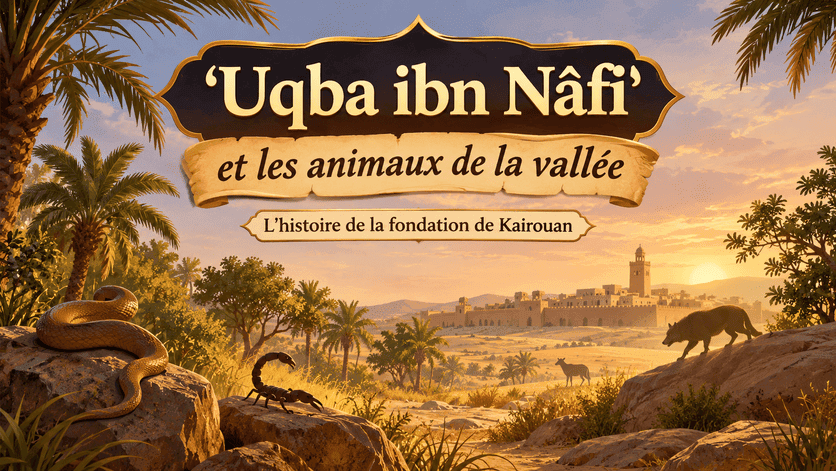
It was a place covered with vegetation.
There were trees, bushes and many natural hiding places.
And above all…
This place was inhabited.
Not by inhabitants living in houses.
But by all kinds of animals.
Snakes.
Scorpions.
And wild beasts.
Some hid under stones.
Others lived among the trees and bushes.
For men who wished to build dwellings and settle with their families, the presence of these animals represented a real problem.
Imagine for a moment.
You arrive in a place where you wish to build your house.
But every time you look under a stone, you risk finding a scorpion.
Every time you move through the tall grass, you may encounter a snake.
And in the bushes hide wild animals.
How can you establish a city in such a place?
How can you allow the inhabitants to live there in safety?
A solution had to be found.
And this is where the most astonishing event of our story begins.
‘Uqba ibn Nâfi‘ addressed the animals that occupied the place.
But before discovering his words, one must understand something important.
‘Uqba ibn Nâfi‘ was a human being.
He did not possess the power to command creation as Allah does.
He could not decide, by his own power, that all the animals would obey him.
Allah is the Creator of all things.
It is He who created humans, animals, mountains, trees and oceans.
And nothing happens without His will.
It is therefore by placing his trust in Allah that ‘Uqba addressed the inhabitants of the valley.
He announced to them that the Muslims were going to settle in this place, if Allah wills.
Then he asked them to leave the place.
He was addressing the animals.
The snakes.
The scorpions.
And the other beasts that lived in this valley.
He said to them:
“O inhabitants of the valley! We are going to settle here, if Allah wills. So leave!”
Then he repeated his call.
A second time.
And a third time.
Three calls addressed to the animals of the valley.
And what happened next was a remarkable event.
The animals began to leave the place.
Beasts came out of the bushes.
Others appeared between the stones.
The snakes and wild animals abandoned their hiding places.
According to some versions of the account, beasts even carried their young.
Imagine this scene.
A valley that, moments before, was occupied by many animals.
And now these animals begin to move to leave the place where they lived.
One after another.
The wild beasts move away.
The snakes come out of their hiding places.
The animals gradually disappear amid the vegetation.
The men present witness this scene.
They see the animals leaving the land on which they wish to build their city.
And this only happened by the permission of Allah.
For Allah is capable of all things.
He knows every creature.
Even the animals that live in the most remote places.
Even those that hide under stones.
Even those that humans cannot see.
Nothing escapes Him.
He knows what is on the earth and in the seas.
He knows what is visible and what is hidden.
And when Allah wills something to happen, nothing can prevent it.
The departure of the animals then allowed the Muslims to begin their settlement.
‘Uqba then said to them:
“Settle, in the name of Allah.”
A place that seemed difficult to inhabit was now going to welcome a new city.
The Muslims began to establish themselves on the chosen terrain.
But building a city required a lot of work.
They had to prepare the locations of the buildings.
Organize the spaces where the inhabitants would live.
Plan the passageways.
And above all, establish a place where the Muslims could perform their prayers.
The foundation of Kairouan is traditionally placed in the year 50 of the Hijra.
The city obviously did not look like the one we know today.
There were not yet the many buildings, streets and neighborhoods that would appear over the centuries.
Everything was to be built.
Little by little, the settlement developed.
Kairouan became an important place for the Muslims of North Africa.
Its name is linked to the history of the Muslim conquests, but also to that of religious science.
For a city is not summed up by its walls and its houses.
It is also the people who live there, the knowledge they transmit and the generations that succeed one another there.
With time, Kairouan became one of the great centers of Islam in North Africa.
Scholars lived there.
Students studied there.
Works were taught there.
And generations of Muslims participated in its development.
But all this happened well after the time of ‘Uqba ibn Nâfi‘.
For when ‘Uqba arrived in this region, he could not see all that the city would become over the following centuries.
He first sought to establish a place where the Muslims could settle.
And this location, once occupied by wild animals, was to become a city whose name would cross the centuries.
Today, Kairouan still exists.
It is located in Tunisia, in North Africa.
More than one thousand three hundred years have passed since its foundation.
Entire generations were born, grew up and lived in this city.
Its streets have changed.
Its buildings were built, rebuilt or transformed.
But its story continues to be told.
Among its most famous monuments is the Great Mosque of Kairouan, also called the Mosque of ‘Uqba.
The building that can be admired today has undergone several transformations over the centuries.
One should not therefore imagine that it has remained exactly identical since the time of its foundation.
But its name still recalls that of the man associated with the birth of the city.
‘Uqba ibn Nâfi‘.
A man whose story is linked to the arrival of Muslims in this region.
And to an astonishing event: that of the animals that left the valley.
What lesson can we learn from this story?
The first is that Allah is capable of all things.
Human beings have limited capacities.
We can build houses, plant trees, learn knowledge and accomplish many things.
Allah, He is the Creator and the Master of all things.
The second lesson concerns trust in Allah.
When a Muslim encounters a difficulty, he must seek the permitted means to overcome it.
He must reflect, act and make the necessary efforts.
But he must never forget to place his trust in Allah.
For the means we use only produce their effects by His permission.
And the third lesson concerns history.
Today, when we look at an ancient city, we see its houses, its mosques, its streets and its monuments.
But we sometimes forget that all this began one day.
Before the great buildings, there was a terrain.
Before the streets, there were paths.
Before the generations of inhabitants, there were the first men who settled there.
And before Kairouan became a city known in the Muslim world, there was a valley occupied by animals.
A valley into which ‘Uqba ibn Nâfi‘ arrived.
And in which this astonishing event occurred, by the permission of Allah.
Thus ends our story.
The story of ‘Uqba ibn Nâfi‘.
And of the animals of the valley of Kairouan.
Listen to this story in the app
The complete text stays free here. In Muslim Guard, children can also listen to the narration and continue through the full library.