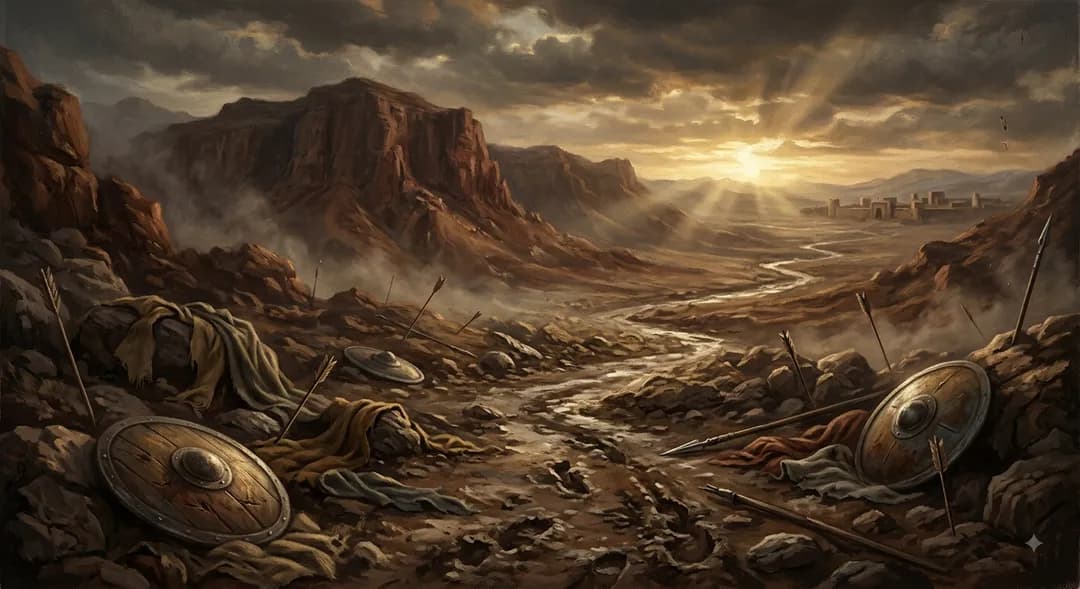
The Battle of Uhud had barely come to an end. The Muslims had suffered heavy losses. Many were wounded. Some still bore on their bodies the marks of the previous day's fighting.
The Day After Uhud
The Battle of Uhud had barely come to an end.
The Muslims had suffered heavy losses.
Many were wounded.
Some still bore on their bodies the marks of the previous day's fighting.
Yet, the very next day, the Prophet Muhammad ﷺ asked his Companions to set out again.
He wanted to show the Meccans that the wounds of Uhud had not broken the believers' determination.
The Muslims therefore went out towards Hamrâ' Al-Asad, located about fifteen kilometers south of Medina.
The Prophet ﷺ asked that only those who had taken part in the Battle of Uhud accompany him.
An exception was however granted to Jâbir Ibn 'Abdillah رضي الله عنه.
Jâbir had not fought at Uhud.
His father had asked him to stay with his sisters while he himself went off to fight.
But his father had been killed during the battle.
This time, Jâbir asked the Prophet ﷺ for permission to go out with the Muslims.
The Prophet ﷺ accepted.
Wounded Men Who Still Answer the Call
Most of the men who set out again were still tired and wounded.
Yet they answered.
Allah mentions those who, despite their wounds, answered the call of Allah and His Messenger.
The Muslims thus headed towards Abû Sufyân and the Meccans.
When the latter learned that the Muslims had again come out of Medina to face them, they hesitated.
Some wished to return to Medina.
Others wanted to continue their journey to Mecca.
Finally, they decided to continue on their way.
No new battle took place.
But the events that were to follow would prepare an even greater threat.
The Pact of Medina
Since his arrival in Medina, the Prophet ﷺ had concluded agreements with the various communities living in the city.
These agreements guaranteed, among other things, religious freedom and the protection of the inhabitants.
But they also included an important obligation:
if Medina were attacked from outside, those who had signed the pact had to participate in its defense and not support the enemies of the city.
Among the tribes concerned were the Banû An-Nadîr.
But their relationship with the Muslims was soon to break.
The Plot of the Banû An-Nadîr
The Prophet ﷺ went one day to the Banû An-Nadîr.
He was accompanied, among others, by Abû Bakr, 'Umar, and several Companions.
The members of the tribe declared that they would honor their commitment, but asked first to consult among themselves.
The Prophet ﷺ and his Companions then waited near a wall.
Meanwhile, some of the Banû An-Nadîr prepared a plot.
They planned to kill the Messenger of Allah ﷺ by dropping a huge rock on him from the top of the wall.
But the Prophet ﷺ was informed of their plan.
He immediately got up and left the place with his Companions.
The pact had been betrayed.
The Exile
After this event, tension rose quickly.
The leader of the hypocrites of Medina, 'Abdullah Ibn Ubayy, even offered his support to the Banû An-Nadîr against the Muslims.
The Prophet ﷺ then decided to act.
The Banû An-Nadîr were besieged.
Part of their palm groves was cut down.
Finally, the tribe left Medina.
A large part of its members took refuge in Khaybar, located north of the city.
Others left for the Shâm.
But their departure did not mean that the danger was over.
Some of their leaders had not given up.
A Meeting at Badr
At the end of the Battle of Uhud, Abû Sufyân had given the Prophet ﷺ an appointment the following year at Badr.
The Prophet ﷺ had accepted.
One year later, in the month of Sha'bân of the fourth year of the Hijra, the Muslims therefore went to Badr.
They stayed there for eight days.
But the Meccans did not come.
Abû Sufyân had indeed prepared an army.
However, on the way, he decided to return to Mecca because of the drought and the lack of provisions needed to feed his men.
The Muslims therefore returned to Medina without fighting.
But meanwhile, elsewhere, a much more dangerous alliance was beginning to take shape.
An Idea of Revenge
In Khaybar, some notables of the Banû An-Nadîr had not forgotten their expulsion from Medina.
Among them was Houyaï Ibn Akhtab.
An idea took shape:
the enemies of the Muslims must stop fighting separately.
They must unite their forces.
Representatives of the Banû An-Nadîr therefore went to Mecca.
They met the Qurayshites.
Their proposal was simple:
to form a huge coalition to attack Medina and put an end to the Muslim presence.
Abû Sufyân and Quraysh accepted.
But that was not enough.
Other tribes still had to be found.
The men therefore left Mecca and headed towards another important power of the Arabian Peninsula:
Ghatafân.
If this tribe also accepted...
the Muslims would no longer face a single army.
They would face a coalition like they had never yet seen.
To be continued…