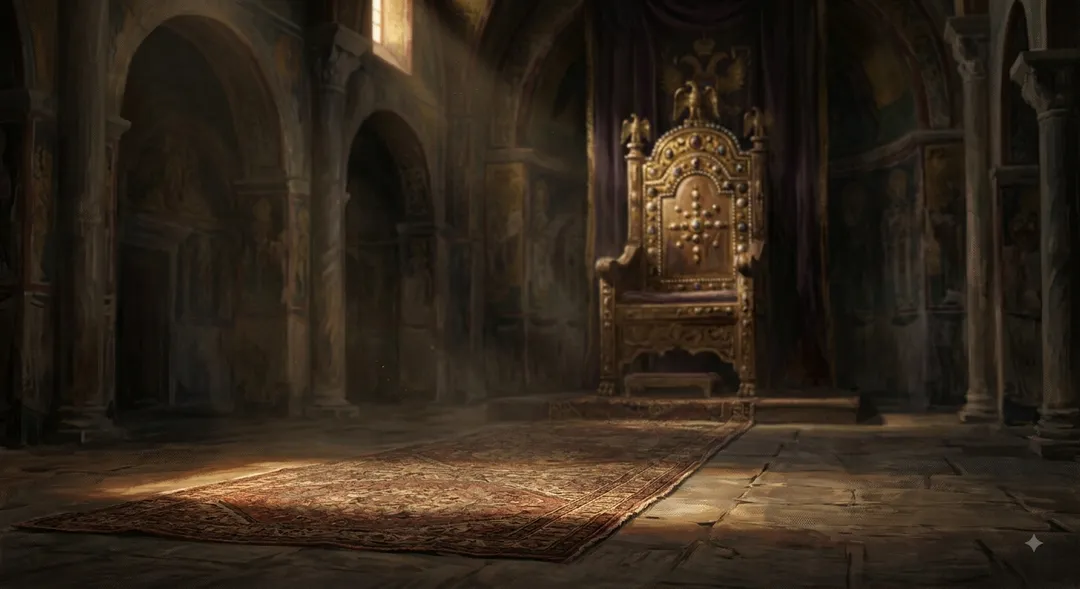
During a truce between the Muslims and Quraysh, Abu Sufyan travels to Sham for trade. But he and his companions are suddenly brought before Heraclius, the mighty emperor of the Byzantines.
Episode 1
A truce had been concluded between the Messenger of Allah ﷺ and the Qurayshites of Mecca.
A truce is a period during which two sides that have been fighting agree to suspend hostilities.
At that time, Abu Sufyan ibn Harb was not a Muslim.
He was still among the opponents of the Prophet Muhammad ﷺ.
Taking advantage of this period of calm, he set out with several men of Quraysh to trade in the region of Sham.
Sham referred to a vast region that included the present-day territories of Syria, Palestine, Jordan, and Lebanon.
Abu Sufyan had therefore come to trade.
But his journey was about to take a direction he certainly had not planned.
Men Came to Fetch Them
While Abu Sufyan and his companions were in that region, men sent by Emperor Heraclius found them.
Heraclius was the emperor of the Byzantines.
The Byzantines formed a powerful Christian empire that then controlled vast territories.
The emperor wanted to speak to these Arabs who had come from Mecca.
Why?
Because he had heard of a man who had appeared among them.
A man who claimed to be sent by Allah.
Muhammad ﷺ.
Abu Sufyan and his companions were brought before Heraclius.
According to the account reported by Abu Sufyan, they were admitted to the emperor while he was with the great figures of his kingdom.
Heraclius was surrounded by the Byzantine notables.
A notable is an important person in a society, by his position, rank, or influence.
Abu Sufyan thus found himself before one of the most powerful men of his time.
But Heraclius did not want to hear about their trade.
He had only one concern.
He turned to his interpreter.
An interpreter is a person who translates words from one language to another.
Then the emperor gave an order:
— Ask them which of them is the closest relative of this man who claims to be a prophet.
Among all the Qurayshites present, someone had to answer.
Abu Sufyan said:
— Me.
"What Is Your Kinship?"
Heraclius asked:
— What is the kinship between you two?
Abu Sufyan replied that he was his paternal cousin.
At that moment, among the men present with him, no other belonged to the Banu 'Abd Manaf.
Heraclius then ordered:
— Bring him forward.
Abu Sufyan was placed before the emperor.
Then Heraclius asked that his companions be placed behind him.
Very close.
Close enough to hear what he was going to say.
Abu Sufyan did not yet know what questions would be asked of him.
But Heraclius immediately announced a rule.
He said to his interpreter:
— Tell his companions that I will question this man about the one who claims to be a prophet. If he lies, let them contradict him.
Abu Sufyan found himself trapped.
He was still an opponent of Muhammad ﷺ.
He might have wanted to diminish his worth before the emperor.
He might have taken the opportunity to speak ill of him.
But behind him were his own companions.
And if he lied...
they could immediately point it out.
Abu Sufyan later said:
— By Allah! If I had not been ashamed that my companions would later say that I had lied, I would have lied.
So he wanted to avoid anyone being able to say:
"Abu Sufyan is a liar."
He would have to answer honestly.
Even if the answers did not please him.
The First Question
Heraclius began:
— What is his lineage among you?
Lineage refers to the family and ancestors to which a person belongs.
Abu Sufyan replied:
— Among us, he is of high lineage.
Muhammad ﷺ thus belonged to a family known and respected among Quraysh.
Heraclius did not comment yet.
He asked a second question:
— Did anyone among you make the same claims before him?
In other words:
had anyone, before Muhammad ﷺ, already similarly claimed to be a prophet among them?
Abu Sufyan replied:
— No.
Heraclius continued.
— Had you ever accused him of lying before he said what he says today?
This question was more delicate.
Before Muhammad ﷺ announced his mission as a prophet...
had he been known as a liar?
Abu Sufyan might have preferred to be able to answer yes.
But he had to tell the truth.
— No.
One Answer After Another
Heraclius then asked another question:
— Was any of his ancestors a king?
Abu Sufyan replied:
— No.
No king among his ancestors.
No lost throne he would seek to reclaim.
No family power he would claim in the name of the past.
The emperor continued to ask his questions methodically.
One question.
Then another.
Then yet another.
Abu Sufyan answered.
And behind him, his companions listened.
So far, he had not been able to say anything that would make Muhammad ﷺ out to be a liar, a man seeking to reclaim a kingdom, or someone copying a claim already known.
Heraclius still had not explained why he was asking all these questions.
Then he asked a new one.
A question that this time concerned those who had chosen to follow Muhammad ﷺ.
He asked:
— Are those who follow him the nobles and the powerful among you...
or rather the weak?
Abu Sufyan had to answer again.
And the further the questions went...
the harder it became to understand what the emperor was exactly trying to find out.
Why was Heraclius so interested in every detail about Muhammad ﷺ?
And what did he intend to do with all these answers?
To be continued...