A prisoner condemned to death, Khubayb sees his enemies' child approach him while he holds a razor. What he will do at that moment will mark their family forever.
A child had just approached a prisoner condemned to death.
The prisoner was named Khubayb ibn 'Adi, may Allah be pleased with him.
His hands were bound.
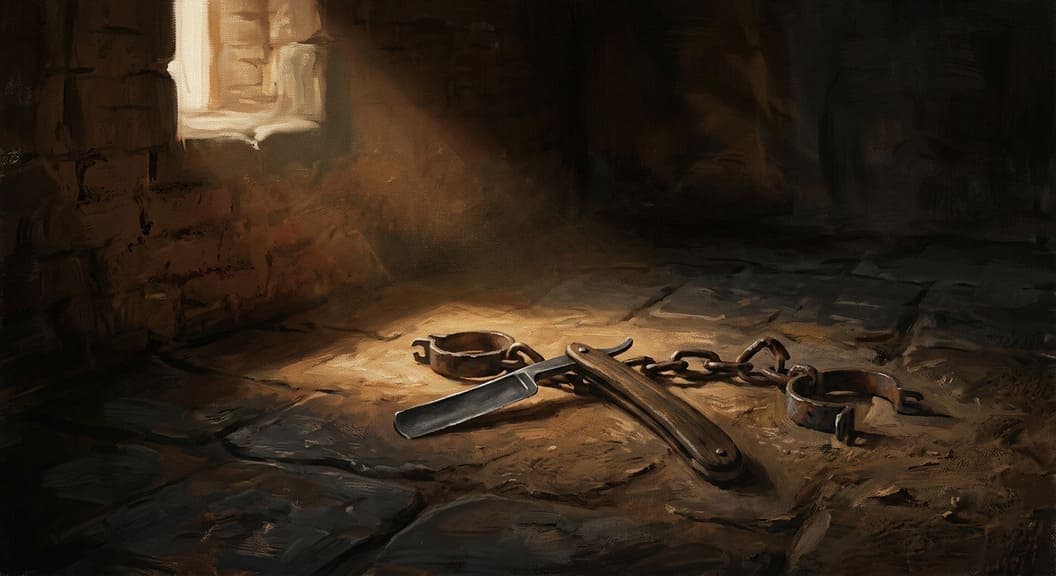
And in one of them… he held a razor.
Without realizing the danger, the little boy came closer, until he sat on the knees of Khubayb, may Allah be pleased with him.
When his mother turned around and saw the scene, she froze.
Her child was alone with the man her family was about to kill.
And that man had a blade in his hands.
Khubayb, may Allah be pleased with him, looked up at her.
He immediately understood what she had just thought.
So, calmly, he asked her:
"Are you afraid that I will kill him?"
Then Khubayb, may Allah be pleased with him, added:
"I would never do that, if Allah wills."
The woman never forgot these words.
For Khubayb, may Allah be pleased with him, had every human reason to resent them.
He had been betrayed.
Captured.
Bound.
Sold.
And he now knew that they had decided to kill him.
Yet, when the child of those who held him prisoner found himself defenseless in his hands…
Khubayb, may Allah be pleased with him, did him no harm.
To understand how he had come to this, we must go back some time.
The Prophet sallallahu alayhi wa sallam had sent a small group of his companions on a mission.
Among them was Khubayb ibn 'Adi, may Allah be pleased with him.
The group was commanded by 'Asim ibn Thabit, may Allah be pleased with him.
But on the way, their traces were discovered.
Men began to pursue them.
They were many.
And many were excellent archers.
When the companions realized they were being followed, they took refuge on elevated ground.
But very quickly, their pursuers surrounded them.
They then made them a proposition.
They promised that if they came down and surrendered, no one would be killed.
'Asim ibn Thabit, may Allah be pleased with him, refused.
He did not trust them.
Arrows then began to fall.
'Asim ibn Thabit, may Allah be pleased with him, and several of his companions were killed.
In the end, only three men remained.
Among them was Khubayb, may Allah be pleased with him.
The pursuers renewed their promise.
They swore to them that they would not kill them if they agreed to come down.
This time, the three men accepted.
But as soon as they were in their hands, their enemies detached the strings from their bows and used them to tie their prisoners.
One of the three companions immediately understood.
He told them in substance:
"This is the beginning of the betrayal."
He refused to go further with them.
They killed him.
Khubayb, may Allah be pleased with him, and his companion Zayd, may Allah be pleased with him, were taken to Mecca.
There, they were sold.
Khubayb, may Allah be pleased with him, was bought by the family of a man named al-Harith ibn 'Amir.
This family had a particular reason to want Khubayb, may Allah be pleased with him.
At the Battle of Badr, al-Harith had been killed by Khubayb, may Allah be pleased with him.
They now wanted revenge.
The days passed.
Khubayb, may Allah be pleased with him, remained a prisoner in their home.
He was bound with irons and knew that one day, someone would come for him.
Then a strange event occurred.
The woman of the house who observed Khubayb, may Allah be pleased with him, would later recount something she had never forgotten.
One day, she saw the prisoner.
Khubayb, may Allah be pleased with him, was still bound.
He could not go out freely.
Yet…
in his hand was a bunch of grapes.
And Khubayb, may Allah be pleased with him, was eating them calmly.
This might already have seemed strange.
But one detail made the scene even more astonishing.
At that moment…
there were no fruits of that kind in Mecca.
The woman herself found only one explanation.
She would say:
"It was only a provision that Allah had granted to Khubayb, may Allah be pleased with him."
Centuries later, scholars would still speak of this event.
They would explain that it was a karamah.
An extraordinary favor that Allah can grant to one of His pious servants.
Khubayb, may Allah be pleased with him, was a prisoner.
Bound.
At the mercy of those who wanted to kill him.
And yet, Allah was able to deliver his provision to him in a way that the people present themselves could not explain.
Ibn Hajar, may Allah have mercy on him, explains precisely in his commentary on this story that Allah tests His servant as He wills, and that He can at the same time honor him.
Then came the day that Khubayb, may Allah be pleased with him, knew had to come.
The family had decided to kill him.
Before he was taken away, Khubayb, may Allah be pleased with him, asked for a razor to prepare himself.
It was lent to him.
It was at that moment that the little boy of the house approached him.
The mother was not paying attention.
The child went up to Khubayb, may Allah be pleased with him.
Then he settled on his knees.
When his mother saw them together, the razor still in the hand of Khubayb, may Allah be pleased with him, she was terrified.
Khubayb, may Allah be pleased with him, noticed immediately.
He asked her:
"Are you afraid that I will kill him?"
Then he answered himself:
"I would never do that, if Allah wills."
Reflect on this scene.
Khubayb, may Allah be pleased with him, knew that this family was going to participate in his death.
A few moments later, these same people were going to take him away to kill him.
He now had their child before him.
He could have sought revenge.
But he did not do it.
Why?
Because a Muslim does not decide what is just or unjust according to his anger.
The bad behavior of others does not give him the right, he too, to become unjust.
Ibn Hajar draws precisely from this account a lesson: the refusal to kill children and the respect of commitments, even in the face of those who have behaved badly.
The woman of the house was so marked by it that she would later say:
"I have never seen a prisoner better than Khubayb, may Allah be pleased with him."
Then the moment arrived.
They took Khubayb, may Allah be pleased with him, outside the sacred territory of Mecca in order to kill him.
Khubayb, may Allah be pleased with him, knew perfectly well what awaited him.
Yet, before anything else, he made a request of them.
He said:
"Let me pray two rak'ahs."
They accepted.
Khubayb, may Allah be pleased with him, then placed himself before Allah.
He prayed two units of prayer.
Then he finished.
And he turned to the men who were waiting for him.
He explained to them that if he had not feared that they would think he was prolonging his prayer because he was afraid of dying, he would have prayed even more.
Even at that moment, Khubayb, may Allah be pleased with him, did not want them to think that his trust in Allah had weakened.
He did not pretend that death was easy.
But something was stronger than his fear.
His certainty.
Ibn Hajar would also say that this story shows the strength of the certainty of Khubayb, may Allah be pleased with him, and his firmness in his religion.
Then he pronounced words that would cross the centuries.
He recited verses whose meaning was:
"It matters little to me, since I die a Muslim, on which side I fall, as long as my death is for Allah."
Then Khubayb, may Allah be pleased with him, was killed.
But those who wanted to humiliate a prisoner had left behind something they had probably never imagined.
The woman who had kept him prisoner had not retained fear from him.
She had not retained anger from him.
She had not retained revenge from him.
She had retained his behavior.
"I have never seen a prisoner better than Khubayb, may Allah be pleased with him."
She had seen a chained man receive a bunch of grapes when there were none in Mecca.
She had seen that same man hold her child in one hand and a razor in the other…
without doing him the slightest harm.
And she had seen him walk toward his death by first asking for a few moments…
to pray to Allah.
Listen to this story in the app
The complete text stays free here. In Muslim Guard, children can also listen to the narration and continue through the full library.