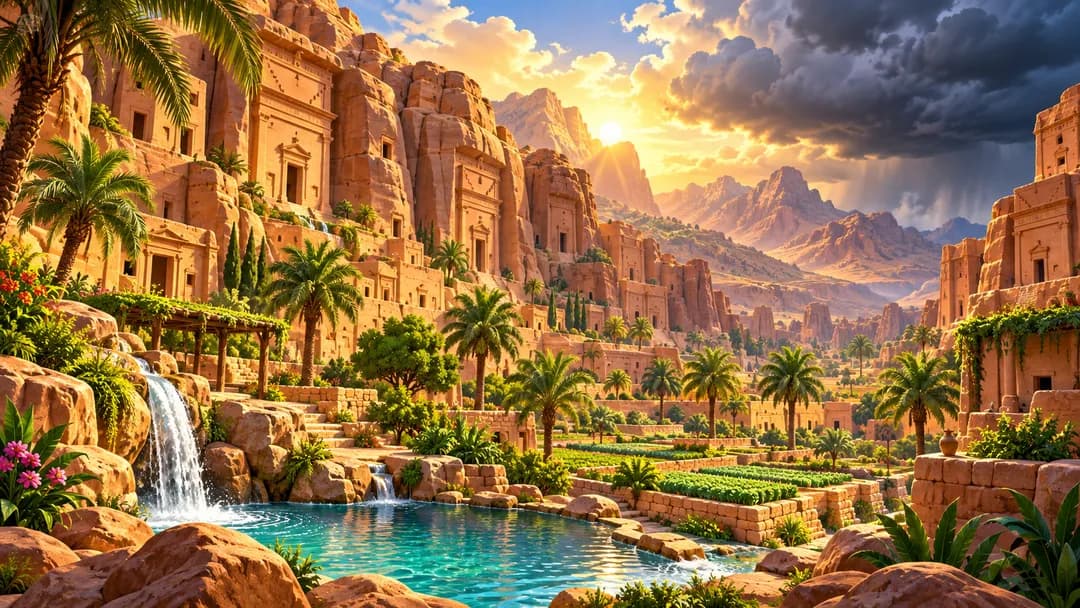
Despite their magnificent houses carved into the mountains and Allah's many blessings, the people of Thamud committed a grave disobedience. Discover their story.
A very long time ago there lived a people called Thamud.
This people lived in a region surrounded by mountains and vast stretches of land.
Allah had granted them many blessings.
They had gardens, springs of water, crops, and palm trees.
They were also very skilled at building their dwellings.
They even knew how to carve and shape the rock of the mountains to make real houses there!
Just imagine the work needed to build a house directly into the stone of a mountain.
Yet, despite all the blessings Allah had granted them, the people of Thamud worshipped other deities besides Him.
So Allah sent them a prophet from their own people.
His name was Salih, ‘alayhi s-salâm.
Salih knew his people well, and the people knew him too.
He called them to abandon the worship of false deities and to worship Allah alone, without associating anything with Him.
He reminded them of the many blessings of their Lord and asked them not to spread corruption on earth.
But a part of his people refused to listen to him.
Some even reproached him for wanting to turn them away from what their ancestors worshipped.
They said to him, according to the approximate meaning of their words reported in the Quran:
— O Salih! Before this, we placed great hopes in you. Will you now forbid us to worship what our ancestors worshipped?
Salih, ‘alayhi s-salâm, continued to call them to the truth.
Some inhabitants believed in his message.
Others, among the most arrogant, persisted in their refusal.
Then one day, those who refused to believe asked Salih to bring them a sign proving that he was truly sent by Allah.
They said to him:
— You are only a man like us. So bring us a sign, if you are telling the truth!
And Allah granted them an extraordinary sign.
A she-camel.
But be careful, this she-camel was not an ordinary she-camel.
Allah had made it a sign for the people of Thamud.
Salih, ‘alayhi s-salâm, announced to them that it was the she-camel of Allah, and ordered them to let it feed freely on the land.
He also warned them not to do it any harm.
For if they harmed it, a terrible punishment threatened them.
And this she-camel had an amazing particularity.
It had to share the water with the people of Thamud.
Allah had set a precise rule.
One day, the water was reserved for the she-camel.
Another day, it was reserved for the inhabitants and their herds.
Everyone had to respect their turn.
The scholars of tafsir also explain that, on the day the she-camel came to drink, the inhabitants could benefit from its milk.
The presence of this she-camel was therefore a real trial for this people.
The inhabitants had to respect Allah's order and let the she-camel live peacefully.
Salih had clearly explained to them what they had to do.
And yet, despite this extraordinary sign, a part of the people continued to reject his message.
The arrogant inhabitants did not want to submit to Allah's orders.
Time passed.
The she-camel continued to live among them and to come to drink when its turn came.
Until the day when some inhabitants decided to commit a terrible act.
They called one of their companions to harm the she-camel.
This man agreed.
And despite the warnings of Salih, ‘alayhi s-salâm,
he killed the she-camel.
The sign that Allah had granted them had just been attacked.
The people had been warned.
They knew that they must not do any harm to this animal.
And yet, those who had rejected Salih's message had dared to disobey.
When this happened, Salih, ‘alayhi s-salâm, announced to them terrible news.
They had only three days left before the punishment announced by Allah would reach them.
It was no longer simply a warning about what could happen if they harmed the she-camel.
They had killed it.
And the punishment was now announced.
Three days.
That was the time they had left.
Then the moment fixed by Allah arrived.
And on that day, a frightening event occurred.
A terrible cry fell upon the unjust.
The Quran also informs us that a violent earthquake struck them.
Those who had persisted in their refusal were destroyed.
Their houses, even those they had carved into the mountains, could not protect them from Allah's punishment.
But Salih, ‘alayhi s-salâm, and the believers who had followed his message were saved.
Allah protected them by His mercy.
They did not suffer the punishment that had struck the unjust.
Salih had nevertheless advised his people.
He had conveyed to them Allah's message and warned them of the consequences of their disobedience.
But those who had shown arrogance had refused his advice.
And this story leaves us several important lessons.
First, we learn that the blessings Allah grants us should drive us to thank Him and obey Him.
The people of Thamud had received gardens, water, crops, and the ability to build impressive dwellings.
Allah had also sent them a prophet to show them the right path.
Then He had granted them an extraordinary sign with this she-camel.
But those who persisted in their pride refused to follow the truth.
This story also teaches us the importance of respecting Allah's orders, even when we do not immediately understand all the wisdom they contain.
For the inhabitants of Thamud, the order was clear.
They had to let the she-camel feed and respect its day for drinking.
And above all, they must not do it any harm.
A trial that could seem simple, but which revealed their disobedience.
Finally, the story of Salih, ‘alayhi s-salâm, reminds us of something essential.
True success is not measured by the wealth of a people, the greatness of their dwellings, or their power.
It is found in faith in Allah, in His exclusive worship, and in obedience to His commands.
That is how the believers who followed Salih were saved by Allah's mercy.
And that is why this she-camel occupies such a special place in the Quran.
For through its story, Allah teaches us the consequences of pride and disobedience, but also the value of faith and obedience to our Lord.
Listen to this story in the app
The complete text stays free here. In Muslim Guard, children can also listen to the narration and continue through the full library.