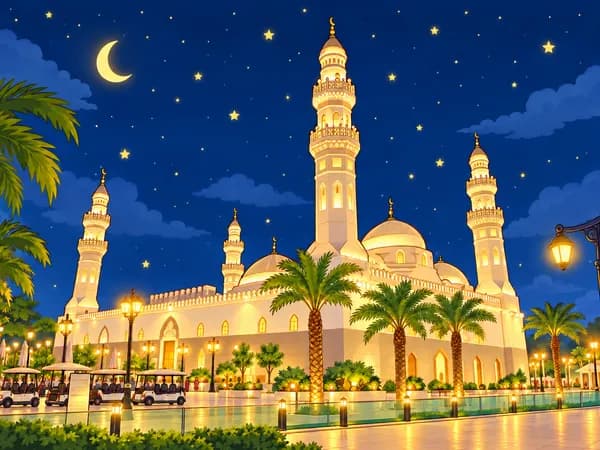
From the Hijrah to the huge current expansion works, discover one of the most important mosques in Medina.
Imagine that you arrive in Medina.
But not in the Medina we know today, with its wide roads, its buildings and its immense mosques.
Go back more than one thousand four hundred years.
The Prophet ﷺ has just left Mecca during the Hijrah.
After this long journey, he arrives at the outskirts of Medina, in a place called Qubâ.
And it is here that a mosque will be built.
A mosque that still exists today.
It is called Masjid Qubâ.
But… What exactly is Masjid Qubâ?
A mosque linked to the Hijrah
Masjid Qubâ occupies a special place in the history of Islam.
It is the first mosque built by the Muslims upon the arrival of the Prophet ﷺ in Medina.
And the Prophet ﷺ did not merely tell the companions to build it.
He himself participated in its construction.
Imagine for a moment.
At the place where this large white mosque stands today, the Prophet ﷺ and his companions were building a place in which the Muslims would pray to Allah.
The Prophet ﷺ continued to return there
But the story of Masjid Qubâ does not stop there.
Even after settling in Medina, the Prophet ﷺ continued to return to this mosque.
‘Abdillâh ibn ‘Omar رضي الله عنه reports that the Prophet ﷺ used to come to Masjid Qubâ every Saturday.
Sometimes on foot.
Sometimes on a mount.
And he would pray two rak‘ahs there.
This shows us something important.
Masjid Qubâ was not only a place linked to an ancient memory.
The Prophet ﷺ really did return there to pray.
An immense reward
And he also taught us something impressive about this mosque.
Whoever performs his ablutions properly at home, then goes to Masjid Qubâ and performs a prayer there obtains a reward similar to that of a ‘Umrah.
Careful: this does not mean that he has actually performed a ‘Umrah and that this replaces the ‘Umrah.
It means that Allah grants him a comparable reward.
That is why, even today, many Muslims who visit Medina also wish to go and pray at Masjid Qubâ.
A mosque that has changed a lot
But if you could see the mosque as it was at the time of the Prophet ﷺ, then compare it to the one today, you would probably find it hard to believe that it is the same place.
Over the centuries, Masjid Qubâ has been restored and enlarged many times.
‘Othmân ibn ‘Affân رضي الله عنه renovated it.
Later, ‘Omar ibn ‘Abd Al-‘Azîz also participated in its enlargement, and it was during this period that a minaret was added.
Then other renovations took place over the centuries.
Today, the mosque as we know it has four large minarets, each about forty-seven meters high.
It also has sixty-two domes.
And with its buildings and service areas, it extends over about thirteen thousand five hundred square meters.
To give you an idea, that is much larger than the small mosque of the beginnings.
An immense expansion project
And the story continues still.
An immense expansion project has been launched around Masjid Qubâ.
The goal is to bring the whole to about fifty thousand square meters and to be able to accommodate up to about sixty-six thousand people.
That would make this extension the largest in the entire history of Masjid Qubâ.
So think about that.
More than one thousand four hundred years ago, the Prophet ﷺ arrived at Qubâ during the Hijrah and participated in the construction of a mosque.
Generations then passed.
The building changed.
It was enlarged.
Rebuilt.
Restored.
New minarets were raised.
Thousands of Muslims can now pray there at the same time.
But one thing has not changed:
Muslims continue to come there to worship Allah and to follow the Sunnah of the Prophet ﷺ.
That is what, exactly…
Masjid Qubâ is.
Listen to this story in the app
The complete text stays free here. In Muslim Guard, children can also listen to the narration and continue through the full library.